

Gay for Pay
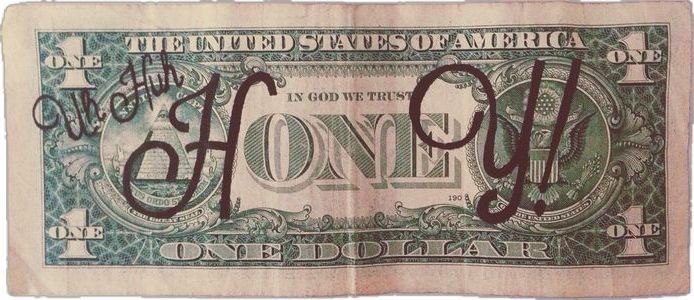
Gay for Pay
I recalled somebody contacting me once, casually, the way people do online now—half social, half ambiguous. He wanted to hang out. As we talked, I realized this wasn’t exactly courtship, though it wasn’t purely transactional either. I teased out the story slowly. I had never met a male sex worker before. He had contacted me with the intention of courtship, or something adjacent to it, and over time he told me about his life.
He was from Brazil. He had moved to Massachusetts with a fairly ordinary goal: he wanted to buy a house. Not a mansion, not a speculative investment—just a home. Specifically, he talked about Malden. He had done the math. Working legitimate jobs, even full-time, he could not save fast enough to put down a down payment. Housing prices rose faster than his wages. So, for four years, he did sex work.
He described it plainly. He sold sex to men while identifying as straight—what is often called “gay for pay.” He wasn’t framing it as a statement about sexuality. It was a job. He talked about logistics, clients, time. He mentioned watching porn while doing it, the way someone might mention listening to music during a shift. Watching porn on his phone helped him imagine he was some place else well engaging with another man. He could not orgasm if he looked down and saw another man on his dick. There was no dramatic confession, no insistence on trauma, but also no claim that it was meaningless. It was something he did in order to enter the economic system on terms that would otherwise have been unavailable to him.
He did not say he sacrificed himself. He did not say he was liberated by it either. What he emphasized was that it got him the money he neede. He also need another sex worker to talk to.
Work Outside the Official Economy
His story made clear something that is often obscured in public conversations about sex work: this is not only—or even primarily—a story about morality or identity. It is a story about capital accumulation.
When formal labor markets fail to provide a viable path toward asset ownership, informal economies fill the gap. Sociologists and economists have documented this for decades. Underground labor—whether unlicensed work, off-the-books services, or criminalized activity—functions as an alternative financial system. It is riskier, lacks protection, and carries stigma, but it often provides access to liquidity that legal employment does not.
Selling sex, in this context, functions similarly to other informal strategies people use to generate capital quickly. It is not framed by participants as deviance so much as strategy.
I asked him did you ever have a female client? He said in 4 years … just one time that’s it. It is almost always gay men who buy sex from me. I agreed and yet it’s not framed as a women’s issue a lot in the media. Even in the word “sex work”, hides the gendered nature of the issue.
“Gay for Pay” Not an Identity
What struck me most was how little sexuality structured his account. “Gay for pay” complicates common assumptions about desire and identity, but in his telling, that complication wasn’t especially dramatic. Clients were not partners. Intimacy was transactional. The work was described in terms of schedules, earnings, and endurance rather than pleasure or self-expression.
It produced income. It allowed savings. It moved him closer to home ownership in a way legitimate employment had not. The payoff was front-loaded. Still, compared to decades of stagnant wages, the calculation made sense.
Housing as the Real Motivator
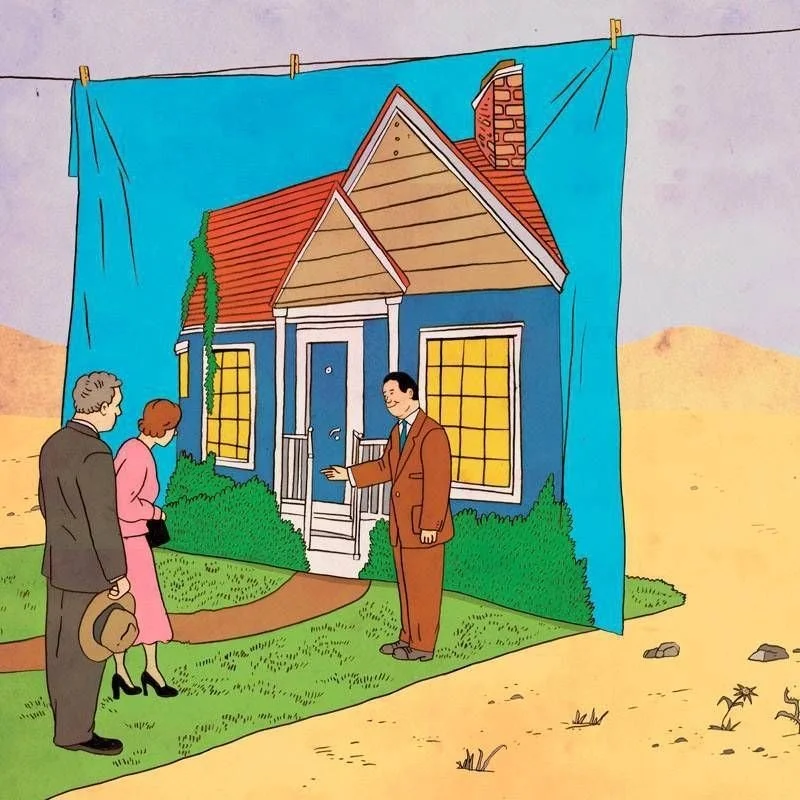
When he talked about why he did it, housing came up again and again. Not luxury, not status—stability. In many cities, home ownership has become increasingly detached from salaried labor. The distance between income and asset acquisition has widened enough that legality itself begins to function as an economic constraint.
This reframes stories like his. They are not anomalies or edge cases. They are responses to structural pressure. Immigration status, limited credit access, and rising housing costs all shaped the choice. The decision was not abstract. It was material.
He wanted a down payment. He found a way to get one.
Beyond Moral Narratives
Public discourse often treats sex work as either exploitation or empowerment. Both frames flatten the economic reality. They shift attention away from the conditions that make such work rational and place the burden of explanation entirely on the individual.
Listening to him, it was difficult to sustain a moralized narrative. He was not making a claim about what others should do. He was describing what he did to participate in an economy that otherwise excluded him from its most basic promise: ownership.
He did not describe himself as transgressive. He described himself as practical.
A Way In, Not an Exception
“Gay for pay,” in this case, is not a story about sexuality so much as a story about access. It shows how people accumulate capital when legal routes are insufficient or too slow. Like other informal economies, it operates as an alternative ladder—one that is unusual to some, but effective.
The question his story raises is not why someone would do this, but why so many people must look outside legitimate labor to reach ordinary economic milestones. Until those conditions change, stories like his will continue—not as exceptions, but as quiet adaptations to an economy that demands entry fees many cannot afford.
Income Inequality Increases More After Government Redistribution - Professor Richard D Wolff https://youtu.be/DlNpofc2_Vg?si=B5LGQy-GKGy2vdHP