


Caliban and the Witch: Women, the Body and Primitive Accumulation
A comprehensive guide to Silvia Federici's landmark work of Marxist-feminist history
This is our scary halloween story, it’s the ruling class….
Introduction
Few books have reshaped how a generation of activists and scholars think about capitalism's origins as much as Caliban and the Witch: Women, the Body and Primitive Accumulation. Written by the Italian-American scholar and activist Silvia Federici and published in 2004 by Autonomedia, the book argues that the rise of capitalism in Europe cannot be understood through land enclosure, wage labor and colonial plunder alone. Alongside these, Federici contends, capitalism needed a sustained assault on women, on their bodies, their labor and their power over reproduction. Its most striking claim is that the witch hunts of the sixteenth and seventeenth centuries were not a medieval relic or an outbreak of superstition but a constitutive part of capitalism's birth.
The title borrows from Shakespeare's The Tempest. Caliban, the colonized and rebellious figure enslaved by Prospero, stands in Federici's reading for the proletariat and the colonial subject, while his mother, the witch Sycorax, represents the women and the knowledge systems that the new order set out to destroy. Federici revised and expanded the text, and a widely read edition from Penguin Classics followed in 2021.
The Author and Her Intellectual Context
Federici was born in Parma, Italy, and has spent much of her career in the United States, including as a professor at Hofstra University. In the 1970s she became a leading figure in the international Wages for Housework campaign, which grew out of the Italian autonomist movement and the work of thinkers such as Mariarosa Dalla Costa and Selma James. The campaign argued that housework, childcare and emotional labor are real work that produces and sustains the workforce, and that capitalism depends on this labor remaining unpaid and unseen.
Before teaching in the United States, Federici spent years in Nigeria, where she witnessed the effects of structural adjustment programs and the privatization of land. She came to see these policies as a new round of enclosure. That experience pushed her to ask a historical question: if contemporary capitalism keeps relying on dispossession and on the devaluation of women's work, where did this pattern begin? Caliban and the Witch is her answer.
The Central Argument
Revisiting primitive accumulation
In Capital, Marx used the phrase "so-called primitive accumulation" to describe the violent processes that separated peasants from the land and created a class forced to sell its labor for wages. Marx treated this as a prehistory that capitalism then left behind. Federici, following scholars such as Rosa Luxemburg and later Marxist-feminists and world-systems theorists like Maria Mies, argues instead that primitive accumulation is not a one-time event but a recurring feature of capitalism. She also argues that Marx's account was incomplete because it was blind to gender.
Her central claim is that the transition to capitalism was a counter-revolution against the gains and the power of the late medieval lower classes, and that this counter-revolution had a specific gendered form. Capitalism did not simply exploit pre-existing patriarchal relations. It reshaped them, creating a new sexual division of labor and a new form of subordination for women.
The devaluation of reproductive labor
For Federici, reproduction, meaning the work of bearing, raising and sustaining the next generation of workers as well as feeding and caring for the current one, is the hidden foundation of all production. As wage labor became the main route to income, work done outside the market, mostly by women, was redefined as non-work, as a "natural resource" or a labor of love. Women were pushed out of many trades and guilds, their wages were kept lower, and they were increasingly tied to the home. She calls the result a "patriarchy of the wage": the wage made the male worker appear to be the sole breadwinner and placed women in a position of dependency on him.
Walking Through the Book
The medieval background: struggle and crisis
Federici begins not with oppression but with resistance. She portrays the late Middle Ages as a time of vigorous class struggle: peasant revolts, urban uprisings, communal movements and heretical sects that challenged both the feudal lords and the Church. In this account, serfs in many regions had won concessions, commons gave ordinary people access to land, forests and water, and women enjoyed more social autonomy than they would later. She is careful to say that the Middle Ages were not a golden age, but she argues that women's work was socially visible and that they took part in many forms of public life and in heretical movements such as the Cathars.
The Black Death of the fourteenth century deepened the crisis. Labor became scarce, wages rose and lords struggled to maintain control. Federici reads the later period as the ruling classes' effort to answer this loss of power, through land privatization, new state powers and the disciplining of the population.
Enclosure, population and the control of women
As the commons were enclosed and peasants were pushed off the land, new social anxieties emerged. Federici describes a growing concern among European states, influenced by mercantilist thinking, with population as a source of wealth and power. Particularly after demographic catastrophes, including the devastation of Indigenous populations in the Americas, rulers began to treat the number of workers as a matter of national interest.
This made women's reproductive capacities a political question. Contraception, abortion and infanticide were criminalized, midwives came under suspicion and state authorities began to monitor pregnancies. Women's wombs, in Federici's language, became public territory. At the same time, women were moved out of independent economic roles, and the household was reorganized around the male wage earner.
The witch hunts
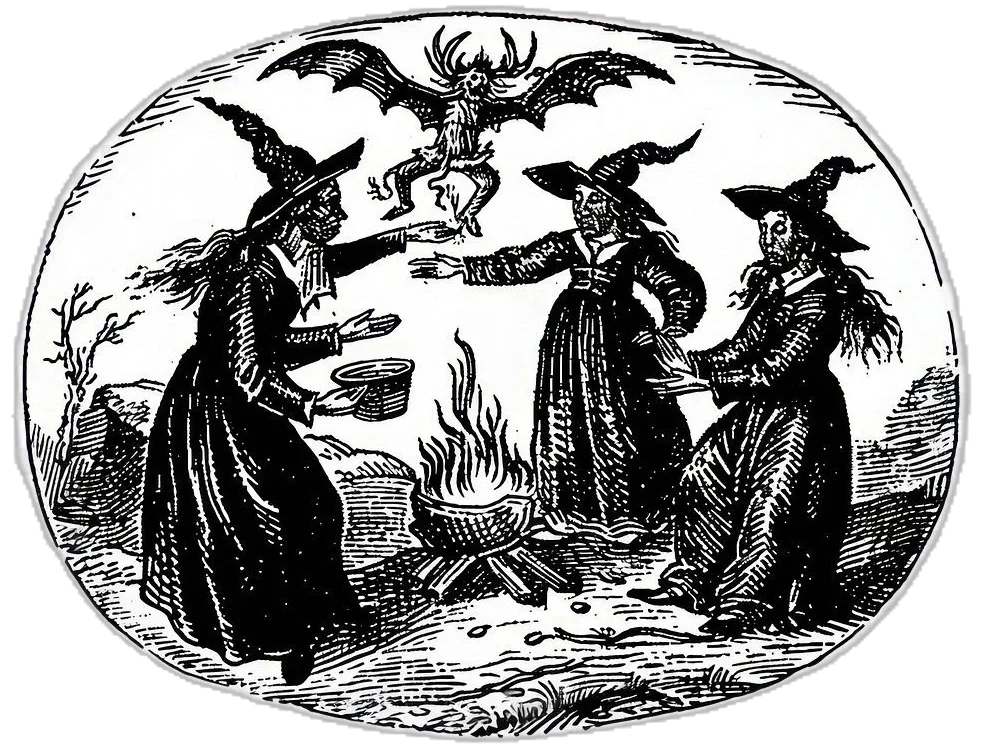
The heart of the book is its analysis of the witch hunts, which she treats in the context of the "great witch-hunt" that swept parts of Europe, most intensely from the late sixteenth to the mid-seventeenth century. Federici argues that the hunts were:
A means of terrorizing and disciplining women who were poor, elderly, unmarried, defiant or economically independent, including those who were healers, midwives or beggars, or who relied on the commons.
A way of criminalizing the control of reproduction, since midwives and women with knowledge of contraception and abortion were frequent targets.
An attack on popular magic, folk belief and communal solidarity, which stood in the way of a rationalized, work-disciplined society.
A campaign that accompanied, and helped to justify, the redefinition of women as dangerous, sexually insatiable and in need of control, which in turn justified male authority over them.
She also stresses that the persecutions were driven by states, courts, churches and local elites, and that they enabled a form of social control that spread fear and encouraged neighbors to inform on one another. Federici notes that the witch hunt later traveled to the colonies, where it was used against Indigenous and enslaved people, and she argues that it echoes in contemporary witch-hunts in parts of Africa, Asia and Latin America, often connected to land disputes and economic change.
Caliban's body: the mechanical philosophy
In the chapter that gives the book its title, Federici turns to the philosophy and science of the period. Thinkers such as Descartes and Hobbes, and the broader movement toward mechanical philosophy, treated the body as a machine: predictable, measurable and separable from the mind. Federici reads this as more than an intellectual development. It reflected, and helped legitimate, the effort to turn people into reliable workers whose energies could be directed and whose spontaneity, sexuality and "unproductive" habits had to be suppressed.
In this reading, capitalism's key challenge was not only to acquire labor but to make the body into labor power, a capacity that can be sold, measured and exploited. The campaign against the body took many forms: moral reform, restrictions on sexuality, the suppression of festivals, the regulation of the poor, and the prosecution of vagrants and idlers. Women, associated with nature and the body, were cast as embodiments of irrationality and disorder, while men were identified with reason.
She engages critically with Michel Foucault here. While acknowledging his analysis of discipline and biopower, she argues that he overlooked the connection between the disciplining of bodies and the demands of capital accumulation, and that he ignored the witch hunts and the reproduction of labor power, which she views as central to the story.
The colonial dimension
The final part of the book places Europe's "internal colonization" of its own peasantry and women alongside the conquest of the Americas. Federici argues that the same set of tools was used on both sides of the Atlantic: religious conversion, demonization of local belief systems, destruction of communal land systems, forced labor and attacks on women's authority. She points to the persecution of Indigenous religious leaders and women, who were accused of devil worship, and to the enslavement of Africans, whose labor made possible much of the wealth that financed the new order.
Here the figure of Caliban returns. Federici draws on Latin American and Caribbean literary traditions that read Caliban as a symbol of anti-colonial resistance, and she insists that the European witch hunt and the colonial conquest should be understood together, as parts of one global process.
Why the Book Matters
Reframing the history of capitalism
The book's lasting influence lies in its insistence that unpaid care and domestic labor are not secondary to capitalism but central to it. This idea has shaped what is now called social reproduction theory, developed by scholars like Tithi Bhattacharya and others, and informs debates about care work, childcare, migration, domestic labor and the gender wage gap. It also influenced feminist activism on issues ranging from reproductive rights to the commons.
Commons and resistance
Federici ends with a call to defend and rebuild the commons, meaning shared resources and forms of cooperation not governed by the market. She has continued this line of thought in later works, including Revolution at Point Zero (2012), Re-enchanting the World (2018) and Witches, Witch-Hunting, and Women (2018). Her argument resonates in contemporary movements around land, water, housing and care.
Criticisms and Debates
Like any ambitious interpretation, Caliban and the Witch has drawn serious criticism, especially from historians. The most common objections include:
Scale and numbers. Federici suggests that hundreds of thousands of women were killed. Most specialist historians today estimate that around 40,000 to 60,000 people were executed for witchcraft in early modern Europe, and note that estimates are uncertain. Federici's figures are considered by many to be inflated.
Gender and who was accused. Historians point out that men made up a significant minority of the accused in some regions, and in some places a majority. They also note that accusations often came from other women and neighbors and arose from local conflict, not only from state policy.
Causality and timing. Critics argue that the witch hunts peaked unevenly across Europe and sometimes in regions with little capitalist development, such as parts of Scotland and Central Europe, while some more advanced economies saw fewer trials. This complicates the claim that witch-hunting and capitalism were directly linked.
A golden-age tendency. Some scholars say that her picture of the medieval world, in particular women's relative autonomy and communal solidarity, is overly rosy and that women faced serious constraints before the sixteenth century.
Sources and method. Reviewers have noted her heavy reliance on secondary literature and a sometimes selective use of evidence to support a unifying theory.
Eurocentrism and generalization. Others question how far a theory built on European examples can be applied globally, or whether it risks flattening distinct regional histories.
Defenders reply that the book is best read as a work of political economy and theory, not as a conventional archival study, and that its value lies in the questions it raises and the connections it makes. They also note that even critics generally accept that the witch hunts disproportionately targeted women and that gender cannot be ignored in explaining them.
The Playbook Today: Reading Federici in the Present
Many readers treat Caliban and the Witch as a manual for recognizing how power operates now, and Federici herself invites the comparison: she argues that primitive accumulation is an ongoing process, not a closed chapter. The parallels below are interpretations drawn by Federici and her readers, not settled history, and they are offered here as lenses for thinking about the present.
The commons and the new enclosures
One influential comparison holds that the enclosure of the commons has a modern counterpart in the capture of data. Where lords once fenced off shared fields, forests and water, today a few corporations collect, own and monetize the information people generate by living their lives. Scholars such as Shoshana Zuboff ("surveillance capitalism") and Nick Couldry and Ulises Mejias ("data colonialism") describe this as a new round of dispossession in which something once outside the market becomes raw material for profit. In the same spirit, Federici points to privatized water, land grabs, patented seeds and the commodification of care as continuing enclosures.
Divide and conquer
A recurring theme in Federici's account is that ruling groups protect their position by turning ordinary people against one another. In her telling, the early modern state drove a wedge between men and women: men were given a small share of power as wage earners and heads of households, while women were cast as dependents and then as threats. Readers see echoes in modern politics, where divisions of gender, race, nation and class are stoked, and where people who speak loudly or break with convention are labeled as dangerous, hysterical or villains. The same pattern, Federici suggests, appeared in the vilification of outspoken, independent women as "scolds" and "witches," and in the suppression of popular festivals, songs, beliefs and customs that bound communities together. Her argument is that organic, local culture is hard to control, so it is repeatedly discouraged, mocked or replaced with standardized forms.
Spectacle and propaganda
The witch trials were public events. Executions were staged as spectacles to teach the population what happened to those who stepped out of line, and neighbors were encouraged to denounce one another. Printed propaganda helped. The Malleus Maleficarum (1486), written by the Dominican inquisitor Heinrich Kramer, is the best-known demonology manual and paid particular attention to midwives and women's sexuality. Historians note that it was controversial even in its own time, that it was one text among many, and that it was not a state document as such. Federici treats it as part of a broader ideological campaign, backed by courts, churches and rulers, that defined who the "good" and "bad" members of society were. Readers draw a line from this to modern media and politics, where powerful interests shape who is cast as hero or villain, and where public shaming, online pile-ons and denunciation can play a similar disciplining role.
Birth, the body and the community
Federici describes childbirth in pre-capitalist Europe as a collective, women-centered event: midwives and female neighbors and relatives gathered around the woman giving birth. As midwives were persecuted and male physicians and the state took charge of reproduction, birth became a more private, medicalized and supervised matter. Some readers take from this a broader point that the care of life should be a communal responsibility and not something left to isolated households, and they cite this as an argument for stronger community, family and public support around childbirth and early childhood.
Women's bodies and poverty today
Federici argues that control over women's reproduction has never stopped being a political question. Laws on abortion, contraception, marriage, divorce and custody still determine, in many places, who decides what women may do with their bodies and lives, and the debate over them remains intense, including in the United States after the Supreme Court overturned Roe v. Wade in 2022. She also connects the devaluation of care work to women's economic position. International bodies find that women are disproportionately affected by poverty, especially older women, single mothers and women in the Global South, though researchers caution that the exact global share of women among the poor is hard to measure and has been revised in recent analyses.
Reading it critically
This present-day application raises its own questions. Critics argue that comparing the early modern witch hunt to modern conditions can flatten important differences in scale, law and rights, and that many of today's disputes have multiple causes beyond a single ruling-class strategy. Supporters reply that the value of the comparison is not an exact match but a way of asking who benefits when communities are divided, resources are enclosed and certain people are made into scapegoats.
Conclusion
Caliban and the Witch is as much a political intervention as a historical study. It asks readers to see capitalism's origins as a story of dispossession and disciplining of bodies as well as land, and it places women, reproduction and colonized peoples at the center of that story. Its empirical claims are contested, and readers should engage with the historians who challenge them. But its core insight, that the invisible work of sustaining life is the foundation on which economic systems are built, has proved enduringly influential, and the book remains essential reading for anyone interested in feminism, Marxism, the history of witchcraft or the roots of the modern world.
Further Reading
Silvia Federici, Revolution at Point Zero: Housework, Reproduction, and Feminist Struggle (2012)
Silvia Federici, Witches, Witch-Hunting, and Women (2018)
Mariarosa Dalla Costa and Selma James, The Power of Women and the Subversion of the Community (1972)
Maria Mies, Patriarchy and Accumulation on a World Scale (1986)
Peter Linebaugh, The Magna Carta Manifesto (2008)
Tithi Bhattacharya (ed.), Social Reproduction Theory (2017)
Michel Foucault, Discipline and Punish (1975), for the counterpoint Federici engages
Brian P. Levack, The Witch-Hunt in Early Modern Europe, for a mainstream historical account