

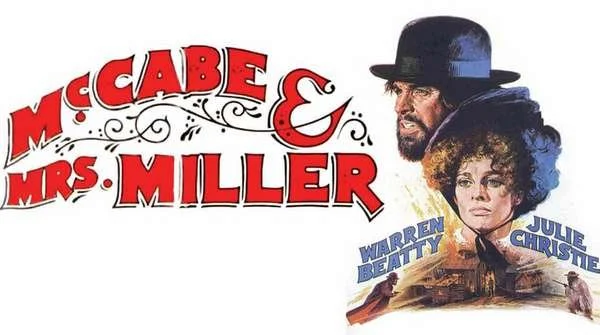
Buying Power: McCabe & Mrs. Miller and the Woman Who Read the Ledger
McCabe & Mrs. Miller asks an urgent question that still feels current: can a small business survive against a company willing to use bribery and violence to get what it wants? The film's answer is bleak, and it's delivered mostly through Julie Christie's Constance Miller, who keeps getting handed the film's intelligence while its title, its billing, and its mythology all belong to him.
Robert Altman's 1971 anti-Western is usually described as a film about a man: John McCabe (Warren Beatty), a gambler who rides into a muddy Northwest mining town called Presbyterian Church, builds a saloon and brothel, and dreams himself into a legend.
The man who thinks he's a story
McCabe is a talker, or really a mumbler. He rehearses speeches to himself, lets the town believe he once killed a man, and tells himself, in one of the film's most quietly devastating lines, that he has poetry in him. He is the American self-mythologizer in miniature, a man whose whole business model is his own reputation.
It's worth remembering how his enterprise begins: he buys the women. The first workers in his brothel are purchased, and one of them is visibly struggling with mental illness (another is an indigenous). The operation starts in dubious circumstances, and McCabe doesn't care about the women as people. They are assets, stock for the business he imagines himself building.
Mrs. Miller doesn't need a reputation. She arrives with an offer: she knows how to run a proper whorehouse, and he doesn't. She is right. Within a few scenes she has upgraded the operation, brought in women, built a bathhouse, and turned a rowdy tent into something with structure, hygiene, and margins. She keeps the books. Where McCabe sees property, she sees people, and by treating the women as workers rather than purely as something to exploit, she humanizes the place. She sets the terms of her own relationship with McCabe, and when he wants her company she treats it as what it is to her, a transaction. It's a cold gesture, and Altman doesn't romanticize it, but it also makes her the only person in the film who is never confused about what anything costs.
Sex work as work
Older Westerns tended to file prostitutes under two headings: the fallen woman who needs saving, or the golden-hearted one who dies nobly. McCabe & Mrs. Miller mostly declines both. The brothel is a workplace, with management, wages, and routine. The women are shown bathing, gossiping, bargaining, and getting through the day, and Altman's overlapping, half-heard dialogue gives them a texture of ordinary conversation that Hollywood rarely gave working women. Shelley Duvall's Ida, a young woman whose options narrow to the brothel, embodies the film's clear-eyed sense of how few doors were open. A feminist reading doesn't need the film to celebrate this labor. It's enough that the film shows it as an economy, one in which the women's leverage is real but limited and always sits inside someone else's larger structure.
Capital arrives
That larger structure turns up in the form of a mining company, whose representatives make McCabe a business offer. McCabe, convinced he's the hero of the story, tries to negotiate for more, and Mrs. Miller sees immediately that the offer isn't really an offer. She knows that in the long run the company will crush their business one way or another. Companies like this take what they want, and the only real question is whether you walk away with money or with a body count. Her advice is to sell. His pride, the thing the whole film has been building up, gets him killed.
This is where the film's feminism becomes structural rather than just characterological. Mrs. Miller understands the power arrangement perfectly, yet she has no legal or institutional standing to act on that understanding. She can advise; she can't decide. She is the partner with the better mind and the lesser authority, which is a familiar arrangement well beyond the Old West.
The ending, and what it costs
The film's final sequence intercuts two events. McCabe, alone in the snow, plays a slow game of survival against the hired killers, while the townspeople rush to put out a fire at the church. Nobody comes to help him. The community rallies around its institution, not around the man who built half its economy. Meanwhile Mrs. Miller sits in an opium den, staring into the middle distance.
It's tempting to read that final image as defeat, and partly it is. She saw the danger and lost anyway, and what she's left with is numbness. But the film doesn't punish her for competence. It suggests instead that a woman who sees the machinery clearly, in a world that won't let her operate it, has to find some way to survive the knowledge. Her withdrawal reads less as moral collapse than as the price of lucidity without power.
The limits of the lens
A fair feminist reading also has to note what the film doesn't do. It is a male director's film about a male-led myth, and the camera, particularly in the bathhouse scenes, doesn't always avoid the gaze it critiques. Mrs. Miller remains, by design, a partial mystery: we never learn where she came from or what she wants beyond security. And the title still puts McCabe first. Altman's real achievement may be that he built a film where the audience is trained to hear that ordering as slightly ironic.
Why it holds up
Ultimately, the film is a cautionary tale about facing a corporate machine you can't defeat, which is the problem at the heart of capitalism: you either get bought out or put out of business. That hasn't changed. Even today, railway workers can't effectively unionize or strike without the government stepping in on the side of the industry.
Leonard Cohen's songs drift over the film like a commentary from another century, wistful and a little mocking of men who want to be remembered. Against that, Mrs. Miller stands out because she isn't interested in being remembered. She's interested in being solvent. In a genre built on men becoming legends, that may be the most quietly subversive stance available, and the film's feminism lies in the fact that it shows her being right and lets us see what being right cost her.
Score: 5/5