

Think back to a time you felt truly loved. Maybe it's a memory of someone's hand finding yours in a hospital waiting room. Maybe it's simpler than that — a friend who showed up with soup when you were sick, or the particular quiet of lying next to someone who knows all your worst habits and stays anyway. Hold that memory for a second. Notice what happens in your chest, your shoulders, your breathing.
That feeling isn't just sentiment. It's biology, and scientists across neuroscience, cardiology, and developmental psychology are only beginning to map how deep it goes — deep enough to shape how long we live, how babies survive their first weeks, and even, some argue, the emotional character of entire cultures.

A quieter kind of medicine
A few years into a long relationship, a man I'll call David realized something odd: he'd quietly stopped needing his old coping mechanisms. He'd smoked for a decade. He drank most nights — nothing dramatic, just enough to take the edge off a day that never quite let him relax. Nothing about his willpower had changed. What changed was that, for the first time, he had somewhere to put the tension instead of into a bottle or a pack of cigarettes. He had a person who noticed when he was off before he said a word. Someone who asked how his day actually was and waited for the real answer. A steady, unglamorous kind of safety that he'd never quite had before.
He didn't quit smoking because he white-knuckled his way through a decision to quit. He quit because he no longer needed the crutch as badly. The cigarettes and the drinks had been standing in for something — a private way of self-soothing in the absence of anyone else doing that work for him. Once real support existed, the healthier habits weren't even a choice so much as a natural drift: he slept better, so he had more patience; he had more patience, so the relationship got easier; the relationship got easier, so he needed the nightly drink even less. It compounded in the good direction instead of the bad one.
It's a very ordinary story, and that's exactly why it's worth taking seriously. Emotional wellbeing doesn't just make people feel better — it seems to free up the bandwidth that self-destructive habits were quietly occupying.

The child who learned not to cry
To understand how deep this runs, it helps to look at what happens when connection is missing early on — and there's a striking case study built right into British history.
For well over a century, upper-class British children were routinely sent away to boarding school as young as seven or eight, pulled out of their homes at the exact age when psychologists now say a child most needs steady, daily attachment. Psychotherapist Joy Schaverien spent years treating adult patients wrestling with the fallout of exactly this and eventually gave it a clinical name: Boarding School Syndrome, the premise that being sent away from home at a young age can inflict a series of psychological traumas with lasting consequences. Journalist Alex Renton, who went through the system himself, later wrote a book about it called Stiff Upper Lip — and the title says almost everything you need to know. For roughly a century and a half, children of that class were trained to do one thing above all else: button it up, keep emotions under control, show a brave face, maintain a stiff upper lip.
The pattern researchers describe is strikingly consistent across accounts: a young child is dropped off, told to be brave, and left in an unfamiliar building with strangers and no one to run to. Crying is discouraged, homesickness is treated as weakness, and within a few weeks most children simply stop expecting rescue and learn to manage entirely on their own. Some researchers who study this now argue that the coping strategies a small child develops to survive that — emotional self-sufficiency, distance, an aversion to being seen as needy — don't just fade with age. They calcify into a personality.
Here's where the theory gets genuinely sociological rather than just personal: some historians and psychotherapists have argued that this wasn't a private tragedy contained to individual families — it was a system that mass-produced a particular kind of adult, at scale, for generations, and then handed that adult an empire to run. A researcher of this "British upper-class complex trauma," as one paper has termed it, has argued that the same avoidant, affect-limited culture forged in early boarding shaped the class that governed much of the world — administrators who could make hard, even brutal decisions at a comfortable emotional distance, in part because they'd been taught, very early and very thoroughly, not to feel too much of anything. Whether or not you accept the empire-scale version of the claim, the smaller version is well documented in clinical practice: adults who describe feeling "fake," disconnected from their own bodies, or unable to access grief and intimacy even when they consciously want to — all traced back to a childhood where love was replaced by discipline and distance was mistaken for strength.
It's worth being careful here — this is one interpretation among researchers studying a specific and unusual institution, not a settled account of how empires are built. But it's a genuinely useful thought experiment, because it flips the usual question around. Instead of asking "does love help us heal," it asks: what happens to a person, and maybe to a whole culture, when love and touch are systematically withheld during the years they're needed most?
What withheld love does to the very young
That question has an even older, stranger answer in a set of experiments most people find upsetting to learn about. In the 1950s, psychologist Harry Harlow wanted to test something the era's leading psychologists took for granted: that infants bond with their mothers simply because mothers provide food. To test it, he separated infant rhesus monkeys from their mothers and gave them two artificial substitutes — one made of bare wire that dispensed milk, the other made of soft terry cloth that dispensed nothing at all. The research showed that infant attachment is driven by contact comfort — the need for physical touch — rather than by feeding. Given the choice, the infants clung to the soft cloth mother for security and comfort, and only reluctantly detoured to the cold wire one when they needed to eat. Harlow eventually concluded that never forming an attachment bond at all does more lasting damage than a bond that's merely disrupted, and that past a certain point, the effects can't fully be reversed.

The findings weren't just about monkeys. Around the same period, and more heartbreakingly, real-world evidence of the same pattern showed up in institutions that were, unintentionally, running the human version of Harlow's experiment. Studies of orphanages found that infants who received adequate nutrition but minimal physical contact showed real developmental delays, while infants who were regularly held and shown affection developed far more normally — a pattern later confirmed, tragically, in Romanian orphanages in the 1980s and 90s, where children given food and medical care but almost no touch or individual attention showed lasting cognitive and emotional effects. The lesson researchers eventually landed on was blunt: babies don't just need to be fed and kept alive. They need to be held. Bonding isn't a bonus feature of infancy — it appears to be a biological requirement, on par with nutrition, for a developing nervous system to organize itself correctly.

The baby who needed to be held
Which brings us to the newborn nursery, and to one of the more remarkable turnarounds in modern medicine.
In Bogotá, Colombia, in the 1970s, infant mortality in the hospital system was running close to 50 percent, and incubators were scarce. Two doctors, Edgar Rey Sanabria and Héctor Martínez-Gómez, tried something almost embarrassingly simple in response: instead of leaving premature babies alone in incubators, they had mothers hold them, skin to skin, for hours at a stretch. Placing premature babies in direct skin-to-skin contact with their mothers helped promote significantly better health outcomes, at a moment when nothing else seemed to be working. They called it kangaroo care, and the name stuck.
It would be easy to dismiss that as an act of desperation from a system without enough machines. But the practice has since been tested formally, in wealthy hospitals with plenty of incubators, and it keeps holding up. A large randomized trial published in the New England Journal of Medicine found that kangaroo mother care — skin-to-skin contact initiated soon after birth for low-birth-weight infants — measurably reduces mortality, not as a supplement to modern neonatal care but as a genuine intervention in its own right. More recent imaging research has found the effect isn't just about survival, either: skin-to-skin contact appears to be neuroprotective and is associated with development in the brain regions involved in emotional regulation in preterm infants. As the study's lead researcher put it, this isn't just about medicine and an incubator — a parent's arms turn out to be a kind of medicine that no machine can substitute for.
Sit with that for a moment: a fragile newborn, barely capable of regulating its own body temperature, is measurably more likely to survive if it's held. Not medicated more, not monitored more — held. If a few hours of contact can tip survival odds for a baby whose organs are still forming, it stops being strange to imagine that connection keeps quietly shaping our health for the rest of our lives.

What's actually happening in the body
The mechanics, as far as researchers currently understand them, run through a small set of hormones that fire whenever we feel close to someone — through touch, eye contact, a shared laugh, or simple reassurance.
Oxytocin, often nicknamed the "bonding hormone," is released during physical affection and emotional closeness. It's associated with lower cortisol — the body's main stress hormone — a calmer heart rate, reduced blood pressure, and researchers increasingly suspect it has anti-inflammatory properties as well. In an odd and still-early line of research, a team at Michigan State University found that oxytocin was the only one of fourteen brain hormones tested that triggered heart-tissue repair in lab-grown human cells and zebrafish, prompting outer heart cells to migrate inward and develop into the muscle cells that generate a heartbeat. It's not something doctors can prescribe yet — it hasn't been tested in a living human heart — but it's a real biological mechanism, not just a nice metaphor, connecting love's chemistry to the body's ability to repair itself.
Dopamine supplies the motivation and mild euphoria of new connection, and seems to counter low mood in the process. Vasopressin works alongside oxytocin to help connection settle into something durable — the felt, physical sense that someone has your back, which in turn helps calm an overactive nervous system. And feeling loved appears to dampen pain itself: in one fMRI study, people in new romantic relationships who looked at photos of their partner while experiencing painful heat reported significantly less pain, with the relief tracked to activity in the brain's reward circuitry — a different pathway than the one activated by ordinary distraction. Love-related reward activity, in other words, doesn't just take your mind off pain. It appears to genuinely blunt the signal.
The clearest, longest-running evidence of all, though, comes from the Harvard Study of Adult Development, which has tracked the same group of people since 1938 — the longest-running study of adult life in the world. Its director, Dr. Robert Waldinger, sums up eight decades of data plainly: good relationships keep people happier and healthier. The study found that people's satisfaction with their relationships at fifty predicted their physical health later in life better than their cholesterol levels did. And crucially, this wasn't limited to romantic partners. Spouses, friends, children, neighbors — all of it counted, and counted about equally. Chronic loneliness and isolation, meanwhile, carried health risks the researchers compared to smoking or heavy drinking.

A world with love prescriptions
There's something almost funny about how much money and research goes into finding the next drug that will lower inflammation, ease pain, or protect the heart — when one of the more reliable interventions on record might just be a good marriage, a close friendship, or a mother's arms around a newborn. No pharmacy stocks it. No insurance code covers it. And yet the evidence keeps pointing in the same direction, from Harlow's monkeys to Bogotá's incubators to eighty years of Harvard data: closeness changes the body, not just the mood.
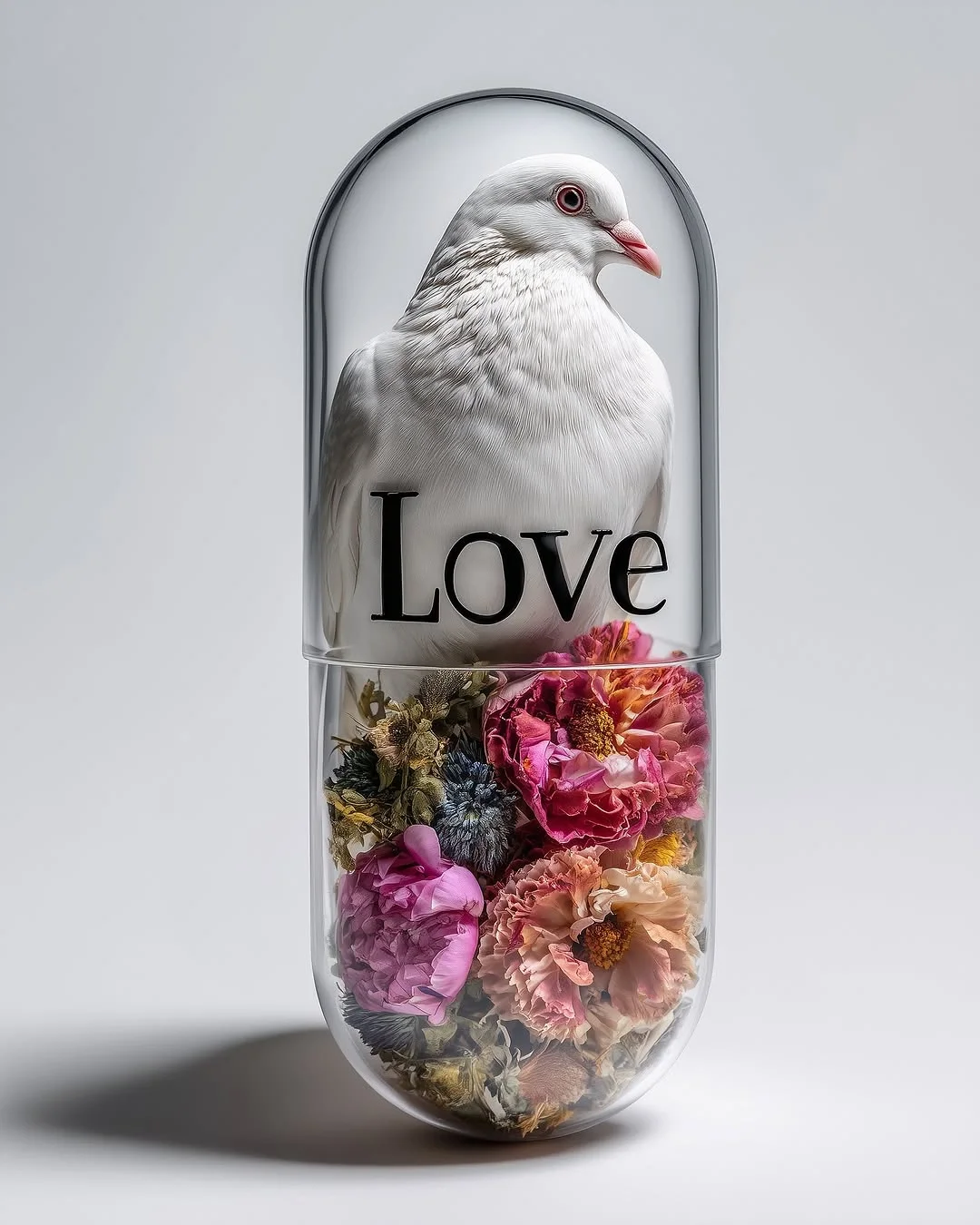
It's worth imagining what medicine would look like if it actually treated connection as treatment — if a doctor, alongside a prescription for blood pressure medication, also asked who's in your corner, and meant it as a real, chartable part of your care plan. Not a nice-to-have tacked onto the visit. A love prescription, written with the same seriousness as anything else in the chart. Refill: ongoing. Dosage: as much as you can get.
So go back to that memory you started with — the hand in yours, the friend with the soup, the person who stayed. Whatever it was, your body was doing something with it, quietly, in the background, whether you noticed or not. It still is.
Here’s a prescription for yourself and for society: love and touch is as important as any pill you’ll take for the quality and longevity of your life. Let’s build a love prescription model in medicine.
Sources
Schaverien, J. (2011, 2015, 2021). Work on Boarding School Syndrome, British Journal of Psychotherapy and related publications.
Renton, A. (2017). Stiff Upper Lip: Secrets, Crimes and the Schooling of a Ruling Class.
Partridge, S. — writing on "British upper-class complex trauma condition" and avoidant attachment in elite culture.
Harlow, H. — classic rhesus monkey attachment experiments (1950s–60s); summarized via Simply Psychology and Psychology Notes HQ.
Research on Romanian orphanage studies and early-life touch deprivation (as referenced in Psychology Notes HQ).
Sentec: "What Is Kangaroo Care in the NICU" — history of kangaroo mother care in Bogotá, Colombia.
New England Journal of Medicine: "Immediate 'Kangaroo Mother Care' and Survival of Infants with Low Birth Weight."
Cornell Chronicle: "Skin-to-skin contact associated with brain changes in preterm infants."
Waldinger, R. — Director, Harvard Study of Adult Development.
Aguirre, A. et al. (2022, Michigan State University) — oxytocin and heart tissue regeneration research