

The Monsters Are Due on Maple Street
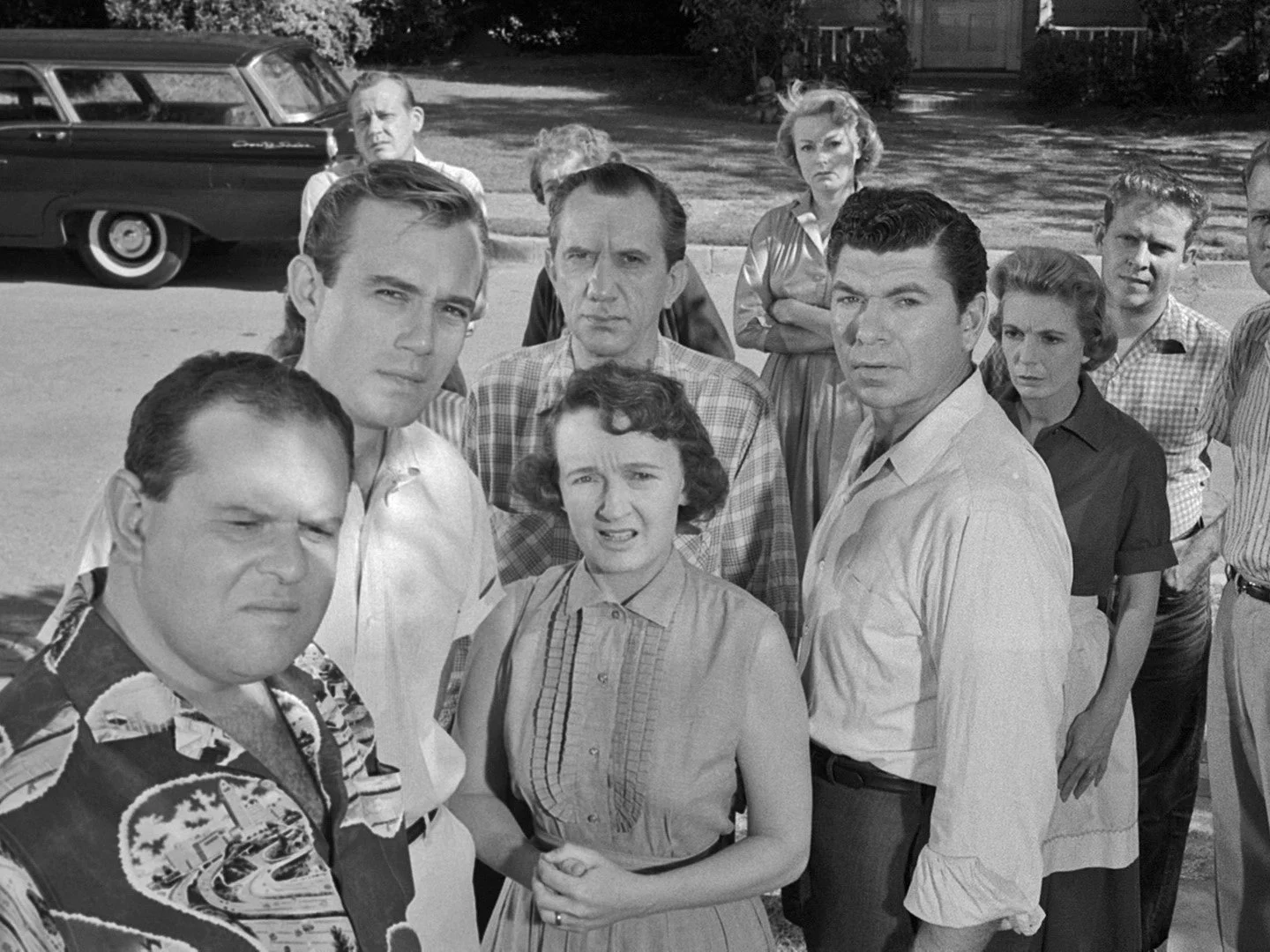
The Monsters Are Due on Maple Street
Rod Serling's 1960 parable about a neighborhood that turns on itself has never been more relevant. Today the manipulators work through screens, not hilltop devices.
The writer behind the story
"The Monsters Are Due on Maple Street" was written by Rod Serling, creator and narrator of The Twilight Zone. It was the 22nd episode of the first season and aired on CBS on March 4, 1960. TIME later named it one of the ten best episodes of the series.
Serling was not a detached observer of conflict. He served as a soldier in World War II, in the Pacific, and saw people he knew die in front of him. He came out of the war acutely aware that death can be senseless, and that the people at the top who send others into danger are often invisible to those who pay the price. After the war he became a Hollywood writer, and he used science fiction to say what could not easily be said on network television in the Cold War era. Aliens and strange worlds let him explore power, fear, and violence, and ask how wars and atrocities happen at all, from a safe distance.
That is why science fiction suits the subject. The forces that shape our lives are often hard to describe directly. A story can make them visible.
What happens on Maple Street
The setting is an ordinary American street on a late summer Saturday: kids playing, neighbors chatting over fences, an ice cream vendor ringing his bell. Then a shadow passes overhead with a roar and a flash of light. Everyone assumes it was a meteor and goes back to what they were doing.
Soon the power fails. Stoves, lawnmowers, cars, phones, and radios all stop working. Neighbors gather in the street, and one of them, Pete Van Horn, walks off to see whether the next street is affected. A boy named Tommy, who has read a comic-book story about an alien invasion, tells the adults that aliens who look human have been sent to cut off the neighborhood. The adults laugh at him.
Then small oddities start to look like evidence. Les Goodman's car starts by itself after he walks away from it, and neighbors recall his late-night habit of standing in his yard looking at the sky. He says he has insomnia. Steve Brand, one of the few calm voices, warns that hunting for a scapegoat is the surest way to destroy the street. But the group turns on him too, because he built a ham radio that no one has ever really seen.
Fear gets worse after dark. A figure approaches in the night. Someone brings out a shotgun, and in a panic Charlie Farnsworth fires. The figure is Pete Van Horn, coming back from his errand. When Charlie's lights then come on, the neighbors turn on him, and he in turn tries to blame the boy. Windows are smashed, weapons come out, and the street dissolves into a riot.
Meanwhile, on a hilltop above the neighborhood, two aliens watch. They are using a small device to flick the power on and off, and they remark on how little it takes, a tweak to the routine, for humans to destroy one another. They plan to conquer Earth this way, one neighborhood at a time, and then fly away. They never fired a shot.
The original warning
The usual reading of the episode is that it's a story about Cold War paranoia, the Red Scare, and the way fear of an enemy within makes ordinary people turn on one another. The episode's final narration says as much: the real weapons of conquest are thoughts, attitudes, and prejudices, and the killing begins when they are used against people's neighbors. The monsters, in other words, are us, but only because someone else pulled the right strings.
Big Tech is the new storyteller
My reading is that Maple Street is the best allegory I know for this moment. In 1960, the manipulators were on a hill with a device. Today, the device sits in our pockets, and the new storyteller is Big Tech.
Platforms decide what we see, what makes us angry, and what we believe about the people next door. Their algorithms reward outrage, and outrage spreads faster than facts. A small tweak to a feed, like the flicker of a streetlight, can change how a whole neighborhood feels. The aliens in the story didn't need to persuade anyone of anything specific. They only needed to disrupt the routine and let fear do the rest.
Tommy is also worth remembering. He is the child who has read the story and understands the pattern, and the adults ignore him. How often are we the same, dismissing the people who warn us about being played?
Who benefits from division?
Look at who stays out of sight. On Maple Street, the neighbors fight one another and the aliens remain invisible, and unharmed. That is the shape of power in this story, and I think it is the shape of ours. As technology sets us against one another, corporations and the oligarchy stay in the background. The ruling class looks united, and the working class looks divided.
Our fights over politics, race, culture, and who is a real American are fought on platforms owned by a few very rich people who profit from our attention however we use it. We scream at each other while they collect.
Why it still matters
The lesson of Maple Street is not that fear is irrational. The neighbors had real reasons to be afraid; the power really was out. The lesson is that fear makes us easy to steer, and that scapegoating is how a community destroys itself. Steve Brand's warning at the start of the crisis was right, and nobody listened.
The remedy is boring and old-fashioned. We should pause before we accuse, ask who benefits from the story we're being told, talk to our actual neighbors, and notice who is not in the fight. If you get a chance to see this episode, it is well worth watching, and worth discussing afterward with the people on your own street.
Notes
Correction: the draft says Serling was a Korean War survivor, but he served in World War II (as a paratrooper in the Pacific). I changed it. His name is also spelled Serling, not Sterling.
Counterpoint: critics of this kind of argument would say that division has many sources, including politics, media, and human nature, and that platforms also connect people and give a voice to those excluded from traditional media. Acknowledging that could make the essay more persuasive.
The Monsters Are Due on Maple Street episode: https://youtu.be/QDdhSP_-TwA?si=wOtW7QyzJyLsE9FB