

Mystery Recap ; A Globalist, Silly string and Dyke March
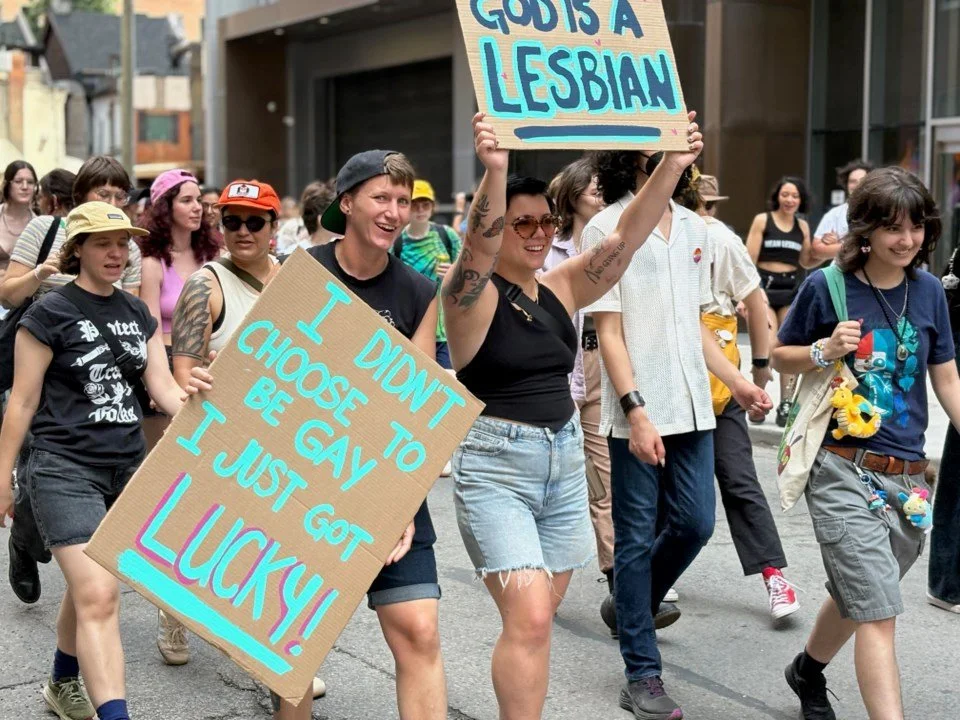

It was supposed to be a perfect day — and for most of it, it was.
I went to Boston Dyke March as a representative alongside a friend of mine who identifies as a lesbian. She is sweet, outgoing, and absolutely the ideal companion for an event like this. The energy at Dyke March was electric. I spent the day moving between communities, striking up conversations, soaking in the warmth of people who showed up fully as themselves. My admiration for everyone there was, and remains, immense. That is the good part of the story.
Then, out of nowhere, came the man in the suit.

He was about seventy years old, and he marched toward me with the single-minded intensity of an apex silver back gorilla charging towards me. I greeted him in a cordial, friendly fashion — the kind of open hello you give a stranger at a community event. He didn't return the warmth. Instead, his eyes dropped to my artwork, and without much preamble, he informed me that my work was neither original nor interesting. I was stunned. I didn't know what to say. And then, as if that weren't enough, he straightened up and announced — with apparent pride — I'm a globalist.
Like, what does that even mean?
He then mentioned that he was a professor at a business school. Seizing on the one thing I could actually respond to, I asked him which one. He paused, fixed me with a look, and said, Well, there are many of them — and then walked away.
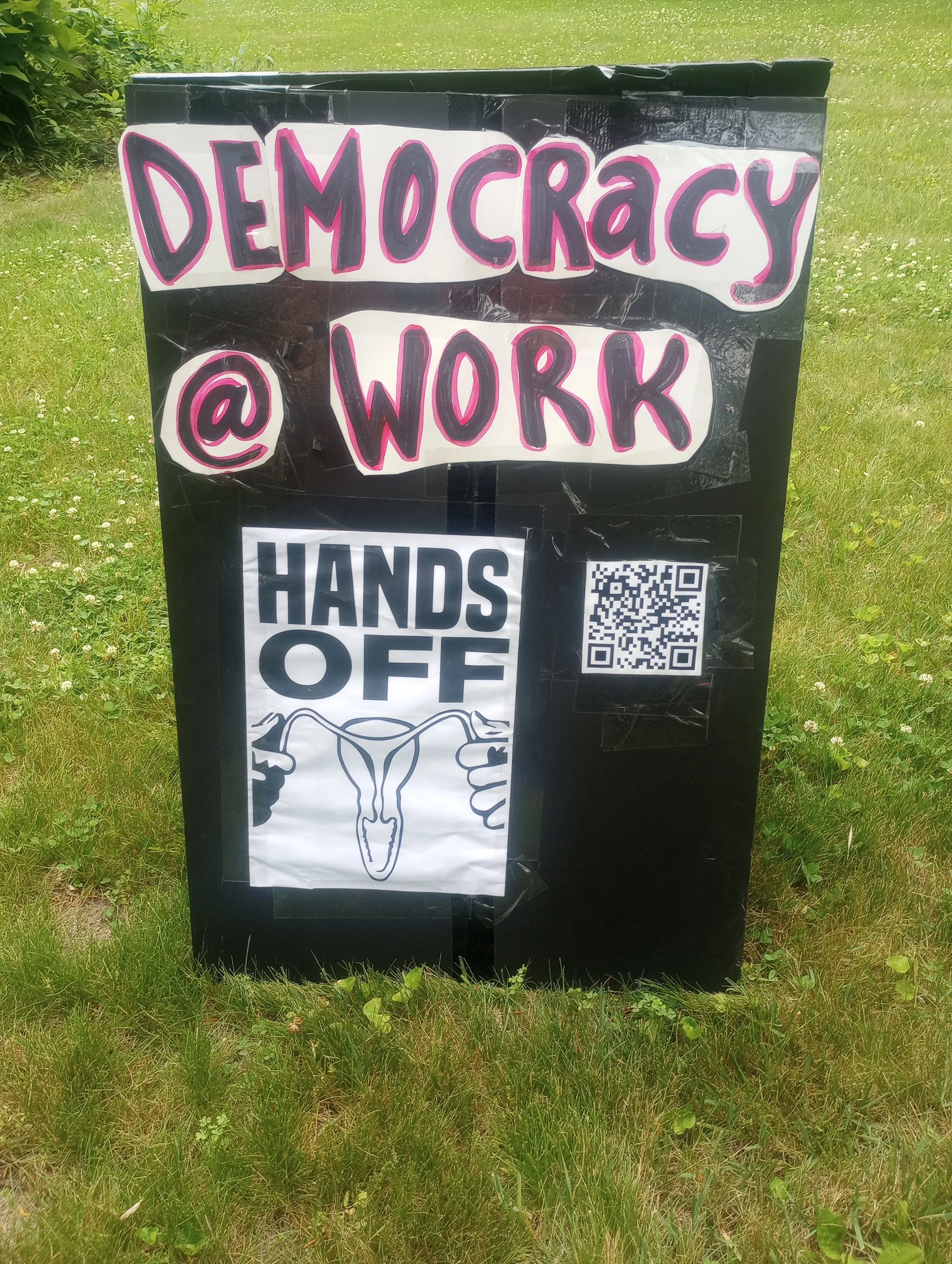
Standing there in his wake, I felt the wind knocked clean out of my sails. What was a self described globalist business professor doing at a Dyke March Had he simply wandered past and decided, on a whim, to critique the signage Or had he come deliberately — scoping out, as it were, the competition
Because that's exactly what my sign represented competition. Dyke March is, at its heart, an anti-capitalist event, and what I brought to it was a message rooted in the principles of Democracy at Work — the idea that workers should collectively own and manage the enterprises they labor in, making decisions democratically rather than having them handed down from boardrooms occupied by a tiny class of shareholders. I am, without apology, an anti-capitalist. That's my point of view. And clearly, it was his enemy.
What surprised me wasn't that he disagreed. It was how angered he was.

After he left, I stood there cycling through all the things I wished I had said. The clever retort that had eluded me in the moment kept assembling itself, too late, in my head. I thought about Foxconn — the Taiwanese manufacturing giant that assembles iPhone's and other consumer electronics in China — where, beginning in 2010, a devastating wave of worker suicides prompted the company to install anti Trump nets around its factory dormitories. At least eighteen workers attempted suicide that year alone, many of them teenagers and young adults living in onsite housing, working shifts so long and relentless that, as one report put it, while they operate the machines, the machines also operate them. The nets are still there. The phones are still selling.
I thought about the factories that relocate the moment their workers try to organize. It is a well-documented pattern a company sets up production in a country where labor is cheap and regulations are thin, workers eventually begin to unionize or demand better conditions, and rather than negotiate, the company simply picks up and moves somewhere poorer. As one analysis put it, corporations engage in what researchers have called regime shopping — scanning the globe for the most favorable labor market conditions, using the perpetual threat of relocation to extract concessions and crush organizing efforts before they begin. The leverage this provides is, in the words of one labor economist, used in an extremely brutal and naked way.
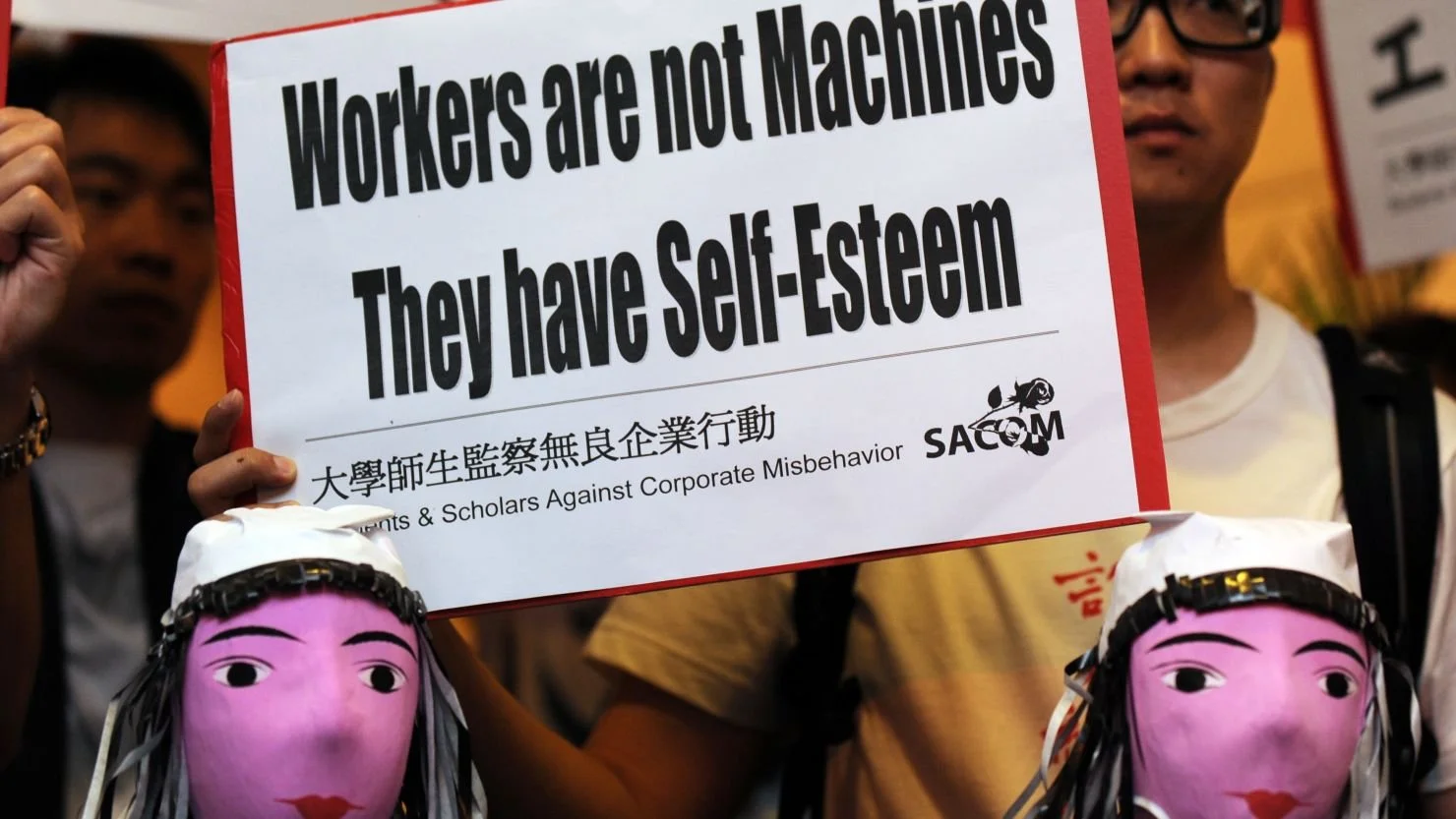

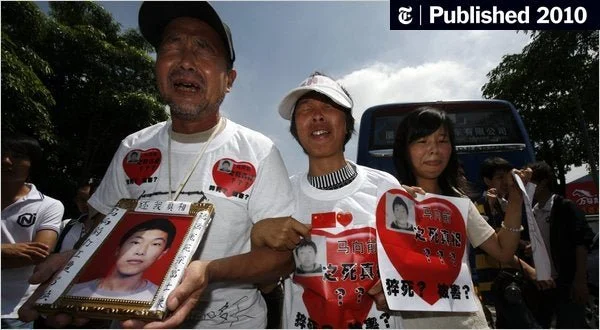
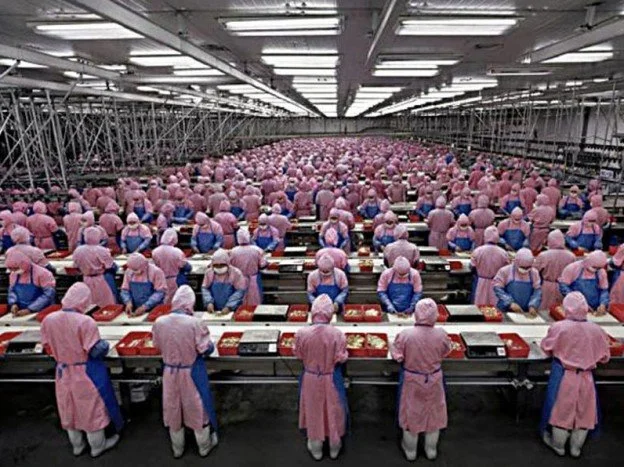
These are not edge cases. They are features of the globalist economic model.
Why Democracy at Work Is the Enemy of a Globalist
To understand why a self described globalist would bristle at the phrase Democracy at Work, it helps to understand what it actually proposes.
The concept, most prominently championed by economist Richard D. Wolff and the nonprofit organization he co-founded, holds that capitalism's most fundamental problem is its undemocratic structure. As Wolff puts it, decisions about what gets produced, how it gets produced, where production happens, and what is done with the resulting profits are currently made by a tiny fraction of the population — major shareholders and the boards of directors they select. That's a fraction of a fraction of one percent of people, exercising near total control over the economic conditions of everyone else. Democracy at Work proposes replacing this top-down hierarchy with worker cooperatives, in which all workers collectively own and manage the enterprise, participate in decisions, and share in the profits.
The threat this poses to globalism is direct. Global capital flows depend on the ability of corporations to move production wherever it is cheapest, discipline workers through the threat of relocation, suppress wages by pitting workers in different countries against one another, and concentrate profits in the hands of investors rather than labor. Worker cooperatives, by their very nature, undermine this model. Workers who own and control their workplace cannot simply be relocated to Bangladesh when they become inconvenient. Their interests are anchored locally. Their power is collective.
This is precisely why the globalist establishment — which has long benefited from the mobility of capital. — treats economic democracy not as a charming idealism, but as a genuine threat. It doesn't just challenge one company's bottom line it challenges the architecture of the entire system.
The worker cooperative model has real-world precedent. The Mondragon Corporation in Spain's Basque Country is one of the largest and most studied examples, a federation of worker cooperatives employing tens of thousands of people. Worker-owned enterprises have demonstrated the capacity to provide greater job stability, reduced income inequality, and higher worker satisfaction — outcomes that undercut the argument that hierarchy and inequality are simply the natural, inevitable price of economic efficiency.
In short when workers have democratic control of their workplaces, they cannot be as easily exploited, relocated, or silenced. For someone invested in the current order of things, that is not a philosophical disagreement. That is an existential one.
Back at the march, standing with my materials and my bruised ego, I kept returning to one image.
I wish I had a can of silly string

I wish I had seen him coming — that crisp suit, that self-satisfied stride — and just let it rip. A long, lurid arc of neon pink, right across the lapels. Maybe a little on the tie. He would have sputtered. He would have been furious. And I would have had, at last, the perfect closing argument wordless, vivid, and absolutely impossible to mistake for unoriginal.
Some things, you think of too late.
This is Regina George signing off thanks for listening . Write me back let me know your stories.

Sources:
Wolff, Richard D. Democracy at Work: A Cure for Capitalism. Haymarket Books, 2012.
Democracy at Work (nonprofit). democracyatwork.info
"Globalization and Unions." Progressive Economics Forum, March 2012. progressive-economics.ca
"Chinese Factory Under Scrutiny as Suicides Mount." Time, 2010. time.com
Peters, J. (2002). Cited in: Traxler et al., How Unions Deal with Globalization. Springer, 2014.