


Picture a guy — call him Alex, 26, a composite of the kind of man researchers keep running into — swiping through a dating app on a Tuesday night. He matches, they text, they meet up, they sleep together. By most accounts, this should feel like a win. Instead, Alex describes the whole thing the way you'd describe a DMV appointment: fine, forgettable, over. He's not depressed about it, exactly. He's just not sure what he expected to feel, and whatever it was, he didn't feel it.
Stories like this keep surfacing in interviews with young adults, and they've started to unsettle a conversation that used to feel settled.
Two Scripts, One Bad Assumption
For decades, there have really only been two socially acceptable ways to talk about what men want sexually. The old script, inherited from patriarchal tradition, says male desire is constant and uncomplicated — a man who isn't chasing sex, or who tries it and comes away cold, must have something wrong with him. The newer script, born of sex-positive and hookup-friendly culture, flips the moral valence but keeps the same math: more casual sex still equals more liberation, more self-actualization, more winning.
Both scripts are built on the same unexamined premise — that how much sex someone is having tracks with how good their life is. Journalist Christine Emba spent years interviewing young people for her reporting and kept finding the same flat affect: even people who'd gone looking for casual encounters described them in oddly deflated, transactional terms afterward. The gap between what people expected to feel and what they actually felt showed up across genders — though it gets talked about unevenly. Women's disillusionment with hookup culture has been written about extensively. Men's version of the same disillusionment is quieter, partly because admitting you wanted more than sex isn't something masculinity has historically made room for.

The Patriarchy Explanation — And Why It's Not the Whole Story
The obvious culprit is patriarchy itself, and there's real scholarship behind that instinct. Sociologist Michael Kimmel has described American manhood as less an inner feeling than a performance — one staged not for a partner, but for the approval of other men, a dynamic he calls "homosocial enactment". Under that lens, sex can function as a signal flare aimed at the locker room rather than an act of connection aimed at the person in the room with you. Bell Hooks pushed the argument further, arguing that patriarchy requires men to wall off their emotions as the price of admission to manhood — which quietly guarantees that the vulnerability real intimacy needs will be in short supply. By this account, a man's hookup-culture malaise isn't a rebellion against patriarchal masculinity; it's a symptom of it. He's been trained his whole life to chase a status marker that was never built to make him feel anything.
The Other Suspects
We're worse at trusting strangers. Robert Putnam's research on the decades-long unraveling of American civic and social life found that people simply have thinner, less durable networks than they used to. Building the rapid-fire intimacy a hookup requires takes a certain baseline comfort with strangers — and that muscle may just be atrophying, independent of anyone's politics about gender.
Our phones trained us for distance, not closeness. Sherry Turkle's work on tech-mediated relationships argues that our devices, for all the connections they generate, quietly condition us to prefer controlled distance over the messiness of real closeness. Dating apps are the purest version of this: they turn people into scrollable inventory, reward speed, and actively work against the slow, awkward accumulation of trust that makes sex feel like something rather than nothing.
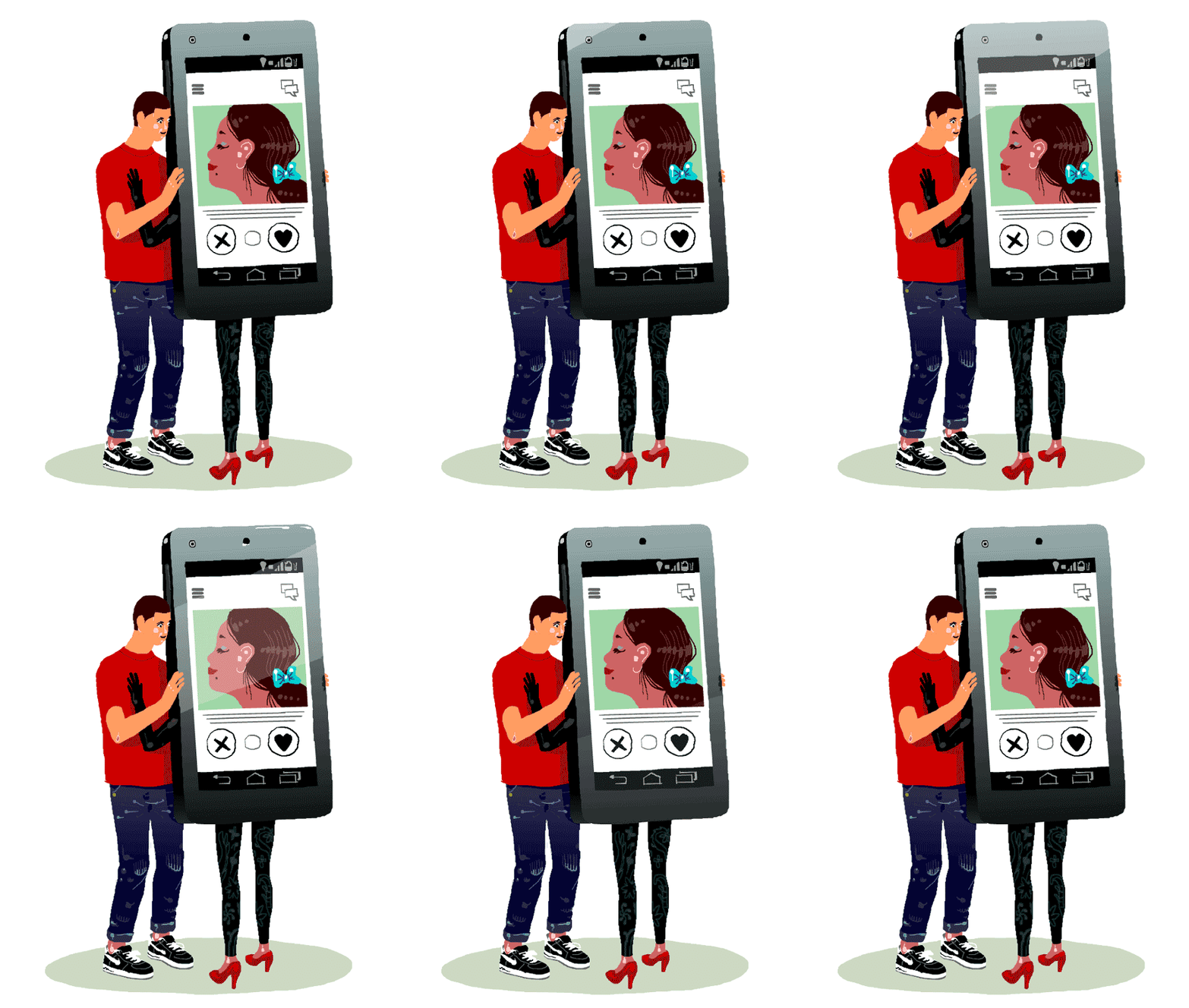
Love has a business model. Sociologist Eva Illouz argues that modern romance runs increasingly on market logic — people get "screened," "evaluated," and chosen (or not) via a running cost-benefit analysis that corrodes the spontaneity intimacy needs. Philosopher Byung-Chul Han makes a related case: a culture obsessed with optimizing and performing produces people who've forgotten how to surrender control, which is precisely what eros requires. Notably, this framework doesn't put patriarchy at the center — it puts the market there, with patriarchal commodification of women as one expression of a much broader phenomenon that also flattens and discards men.
Everyone's more anxious. Psychologist Jean Twenge's survey data tracks a sharp, sustained rise in anxiety and depression among younger generations — a trend line that predates any particular dating app and will likely outlast it. Intimacy needs a baseline of psychological safety to land as intimacy rather than performance; rising background anxiety may be quietly sabotaging casual encounters no matter what cultural script governs them.
The economics of marriage changed. Economists have increasingly located the retreat from marriage not in shifting sexual mores but in labor markets. Sociologist William Julius Wilson's "marriageable male" hypothesis, later extended by economists studying the fallout of trade and manufacturing shocks, ties declining marriage rates to stagnant or falling male earning power — men who can't reliably contribute to household income become less likely to marry, regardless of how much anyone wants intimacy or commitment. June Carbone and Naomi Cahn's research on "marriage markets" adds the other half of the equation: as women have gained greater economic independence, marriage has stopped being a financial necessity for many of them, which changes who has leverage in forming and maintaining relationships. On this account, the emotional flatness people report in casual encounters may be a downstream effect of economic precarity and renegotiated bargaining power between men and women, not evidence of a specifically cultural devaluation of sex.
It's Probably All of the Above
The temptation, once you've laid these theories side by side, is to pick a winner. That's probably the wrong move. Patriarchal norms supply the pressure to chase sex as a status symbol in the first place. Market logic supplies the framework that turns people into options to be evaluated. Dating apps supply the frictionless infrastructure that makes that evaluation instant and disposable. Declining social trust and rising anxiety supply a psychological climate that's bad soil for the vulnerability intimacy actually requires. Stack all of that on top of each other, and you get something closer to the full picture than any single explanation — including the patriarchy-only one — can offer alone.
Strip away the competing theories, and what's left is something more modest than a grand unified explanation, but arguably more important: a lot of people — men very much included — are having the sex they were told to want, and walking away wondering where the promised payoff went.
What Might Help
If the causes are this tangled, the fixes probably have to be too. But "it's complicated" isn't an answer — and there are threads in the research above that at least point somewhere.
Rebuild the infrastructure of trust, not just the dating pool. If Putnam's diagnosis is right — that thinner social networks make it harder to manufacture intimacy on demand — then the fix isn't a better app, it's more of the unglamorous, in-person, repeated-contact institutions that used to produce trust as a byproduct: recreational leagues, religious communities, clubs, third places where people see each other enough times that a stranger stops being a stranger. Several public-health researchers studying the U.S. "loneliness epidemic" have made versions of this same argument, treating social infrastructure as a policy lever rather than a personal failing.
Put boundaries on the tools, not just willpower on the user. Turkle's own prescription was never "delete the apps" — it was building in friction deliberately: fewer matches, slower reveals, conversations that have to happen before a meetup rather than instead of one. A handful of newer dating platforms have started experimenting with exactly this, limiting daily matches or requiring longer profiles, on the theory that scarcity and slowness are features, not bugs, when the goal is connection rather than throughput.
Resist the market logic on purpose. If Illouz and Han are right that the deeper problem is a culture that's forgotten how to do anything other than evaluate and optimize, then the intervention has to be somewhat countercultural: relationships that are allowed to be inefficient, encounters that aren't immediately assessed for ROI, a willingness to stay past the point where the cost-benefit math stops making obvious sense. That's a hard thing to legislate or app your way into. It may be closer to a cultural project — the kind therapists, writers, and educators can nudge, even if no policy can mandate it.
Treat anxiety as its own problem. Twenge's data suggests that some of what's showing up as sexual disillusionment is really just generalized anxiety wearing a hookup-culture costume. That means expanded access to mental health care and, per some researchers, limits on the more compulsive, comparison-driven aspects of social media aren't tangential to this conversation — they may be doing more load-bearing work than any advice about dating specifically.
Fix the economic floor underneath the relationships. If stagnant male earning power and shifting economic leverage between men and women are part of what's driving people away from marriage and toward more transactional short-term arrangements, then some of the most relevant "relationship policy" isn't about relationships at all — it's wage growth, job stability, and affordable housing. Economists studying this link have generally been more confident about the diagnosis than about any specific remedy, but the throughline is clear: financial precarity makes commitment riskier for everyone, and less commitment tends to produce exactly the kind of low-stakes, low-payoff encounters people are describing.
None of these fixes is sufficient by itself, which tracks with everything else in this piece: no single cause got us here, so no single lever gets us out. But naming the mechanisms — rather than settling for a single villain — at least gives people something more actionable than a diagnosis. The dissatisfaction so many are describing isn't a mystery anymore. It's an overdetermined problem with several genuinely promising, if partial, solutions — which is a more hopeful place to end up than where the conversation started.
References
Emba, C. (2022). Rethinking Sex: A Provocation. Sentinel.
Han, B.-C. (2017). The Agony of Eros (E. Butler, Trans.). MIT Press.
hooks, b. (2004). The Will to Change: Men, Masculinity, and Love. Atria Books.
Illouz, E. (2007). Cold Intimacies: The Making of Emotional Capitalism. Polity Press.
Illouz, E. (2012). Why Love Hurts: A Sociological Explanation. Polity Press.
Kimmel, M. (2008). Guyland: The Perilous World Where Boys Become Men. Harper.
Putnam, R. D. (2000). Bowling Alone: The Collapse and Revival of American Community. Simon & Schuster.
Turkle, S. (2011). Alone Together: Why We Expect More from Technology and Less from Each Other. Basic Books.
Twenge, J. M. (2017). iGen: Why Today's Super-Connected Kids Are Growing Up Less Rebellious, More Tolerant, Less Happy—and Completely Unprepared for Adulthood. Atria Books.